Wednesday, November 08, 2006

Another Long-Overdue Wrong To Be Righted: Leaf Blowers

In what has already been a very good news day ; - ) ,
this heartening item appeared in the Boston Herald*:

"Leaf blowers may have to take leave: Cambridge mulls ban"
By Laura Crimaldi, 11/8/06

"Cambridge city officials this week established a Leaf Blowers Advisory Committee to determine whether the noisy lawn and garden machines should be muffled for good or least regulated.

"Last year, Palo Alto, Calif., banned use of the cacophonous gas-powered deleafing devices in residential zones, joining more than a dozen of California communities that have outlawed high-octane leaf blasting or limited the hours that the turbo garden contraptions can be in use.

"The yard-clearing conundrum isn’t just about neighborhood racket, leaf blower naysayers said. It’s also about health risks and actually robbing your lawn of the nutrients needed to stay healthy.

“'Everybody has this idea that it’s important to get the leaves up,' said Karen Carmean, co-chairwoman of the Cambridge Public Planting Committee. (But,) 'it is the best thing for trees to have leaves on the ground around them because it creates leaf mulch.

"The leaf blowers also kick up dust particles that pose a health threat, Carmean said. 'Particulate matter is more dangerous than we thought it was a few years ago.'”
Okay, it isn't known as The People's Republic of Cambridge for nothing. And yes, the price of not cutting your own lawn will go up along with the extra time it'll take to rake.

But I was particularly happy to see this possibility being considered, because them dang things are a pet peeve of mine, and I hadn't even considered the issues of mulch and free-flying particles. Just the damn noise!

Such a peeve, in fact, that i was moved a few years back to vent into my keyboard on the subject; to wit:
It's a Loud, Loud World
Here's a piece of technology that has all the nerve-shredding abilities that we've outlined, but absolutely none of the usefulness, the practical value, of tools that at least accomplish something. The leaf blower just moves unwanted material from one place to the other, where it is equally unappreciated. Its slogan? "Let them clean it up."

Thursday, November 02, 2006

Happy Basketball Season!

In honor of the start of the season:


Let's go Cel-tics! (They say that was Red Auerbach's favorite cheer, and the fans present at last night's Goodbye and Hello game really put their hearts into it.)


Too bad we're in the same conference as,


"Okay, check it in..."


(Logos courtesy of Chris Creamer's SportsLogos.Net.)

Thursday, October 19, 2006

"What will make the Web universal is video"

Virginia Heffernan unfortunately chose her New York Times “Screens” blog Tuesday to make what I thought were some excellent observations about YouTube’s most popular videos, and Web video overall -- and I do mean "over all."

I say unfortunately only because the NYT requires a "free" (in return for your e-mail) subscription to read, which makes linking awkward. But that's carping, isn't it? I mean, you used to have to pay 50 cents a day for the paper. And only today we see again that "Ad Sales Continue to Sag at Major Newspapers." (According to them, it's all Craig's fault.)
Now, if what she proposes is true, it’s not exactly good news around here, because as you’ve no doubt noticed I consider myself, ahem, a writer, and this could easily be seen as implying that there ain’t no big need for me or my kind in the brave new video Webworld.

But though we writers will probably still have something to do for a while yet, I think she’s right, in what reads like a loud manifesto, about where it’s mainly going.
“The Breakthrough of That Dance Video, the Future of YouTube and the Wisdom of Google”
NYT, October 17, 2006

"Why is an overlong mollycoddle mime dancing sketch, 'The Evolution of Dance,' YouTube’s top-viewed video?

"It’s hokey and did I say long and it’s like a chumpy cousin at a family reunion, which is to say — so I’m relenting a little — not entirely without corny charm, but far from groundbreaking or bellwether or cool or Web 2.0. ...

" 'The Evolution of Dance' has drawn more than 34 million views, nearly double the number of the runner-up, because it’s . . .

" . . . not in English. That’s all. No talking. No dialogue, no voice-over, no monologue. No language but lyrics.

"...blogs are not the form that makes the web universal. Neither are news sites, or databases, or Wikipedia, or anything else that’s restricted by language. What will make the web universal, what will turn us into one magical networked planet, what will blow our minds with how much can be said in icons and images and film — and, above all, why Google didn’t overpay for YouTube — is video.”
===
Just for the record, we are not at all sure about the "magical networked planet" invocation there, just so you don't think including it was an endorsement of the dream.

That's a great, swinging paragraph, and we didn't want to risk disturbing the music.

We know it's coming, to some degree or another. The question is, what type of magic will it be?

Monday, October 16, 2006

"H.P. Names Ethics Officer"

(This was just too funny:)

...Because, uh, well, it's kinda complicated, see? We guess what happened was,

"PALO ALTO, Calif., Oct. 12 (AP) — Hewlett-Packard said Thursday that it had named Jon Hoak, former general counsel for the NCR Corporation, as its vice president and chief ethics and compliance officer.

"Mr. Hoak, 57, replaces Kevin T. Hunsaker, who was ousted after his involvement in a boardroom spying inquiry was disclosed last month. Mr. Hunsaker was charged with several felonies in the case..."
Oh, but we're sure we've got a ethical Ethics Officer this time, for real!

(This phrase will forever remind me of a little girl named Janet I once knew, at the time she had just discovered those magic words. She was so thrilled with the tool of "for real" that she used it as the suffix for every statement she made, including the plainly false -- which, bless her heart, accounted for the lion's share of her expression. But we're sure the new New HP will do much better -- for real!)

Saturday, October 07, 2006

Armstrong Quote Scores Some More Points

Having paraphrased and commented around a month back on the usage in Neil Armstrong's justly famed Moon-landing quote, it was funny to see his score for grammar improve only the other day with the news that they found his missing "a."

It turns out that Armstrong always intended to say, "...one small step for a man," but the recording said otherwise. Ah-ha, until some restless Australian programmer went hunting for this legendary beast in the sonic outback, and brought back at least some pictures.

And it only took about 37 years to find out.

One small word is one giant sigh of relief for Armstrong

Times Online, UK - Oct 1, 2006

Software proves Armstrong’s moon quote was grammatically correct

Mumbai Mirror, India - Oct 1, 2006

= = =

In here on Aug. 30, commenting on the second part of the statement, in "Another Giant Leap For Humankind... (TV-B-Gone)" --

Note on the title:
We’ve tweaked an historic quote there, but are sure that if Neil Armstrong had first set foot up yonder in recent times, he’d have put it that way. Kudos and appreciations to Mr. Armstrong, btw, for realizing that was a hugely historical moment, and rising to the occasion. He could have just said, "Roger, Houston, that's a big 10-4, we have touch-down," or something equally dull and functional.

Wednesday, October 04, 2006

Dell Starts Recycling Program with Free Home Pickup

Since I recall making some snarky comments in here recently about the need for a greater sense of social responsibility from tech companies (and we're currently on a theme of giving credit where due), it's only fair to point out Dell Computer's news, this time for something other than flaming laptops or incomprehensible customer support.*

On Friday (9/29), Dell began a U.S. recycling program that features free home pickup of any Dell computer or peripheral. The program was announced in June. "Unlike recycling programs offered by many other manufacturers, the Dell program does not require people to purchase a new product," CNet's story explained.

Here's the Dell site's page on the program, where you can sign up, and they further explain that if you do buy a new computer from them, they'll take anybody's boxes to recycle.

“Among tech companies, environmental advocacy group Greenpeace has singled out Dell and mobile-phone maker Nokia for their ecologically conscientious policies,” CNet said.

Excellent! I’d add that it’s about time a computer manufacturer offered this, but since this is a congratulatory announcement, let's hold off on that for now. (Apple will take your old stuff, too, but only when you bring it in and buy a new machine from them.)

These companies have made fortunes filling the land and landfills with boxes that contain a good dose of toxic substances, poisons that are seeping into the earth under the dumps they’ve been thrown upon. It only seems fair that they pick up their garbage.

CNet: "Dell's no-excuse recycling program begins"

...via the Boston Globe's Business Filter, with links to a number of related stories, notably including:

“Where computers go to die...and kill”

"30 million U.S. computers become obsolete each year and yet we have no nationally-coordinated recycling policy."

Full story from:
http://www.salon.com/news/feature/2006/04/10/ewaste/
* - (But you should have heard me own Mum's distress and frustration at trying to understand what the Indian gentleman was trying to tell her about fixing something on her Dell -- which was probably to reinstall Windows. Apparently it was a very trying experience for all involved).

Monday, October 02, 2006

"Giving Credit Where It’s Due" Dept.

One spirit which I've always found sadly missing from the Internet in general, from smaller, personal websites and pages to the e-mail output of the general populace, is of giving credit for things. Ever notice how few of those eternally popular e-mail collections of witticisms, the ones that thousands of people find just right and send around again and again, are absent any credit for authorship?

It's an odd psychology; I’ve always imagined it was the original senders fearfully thinking, 'If we take out the name of the person who wrote this, then we won't get caught for using it.' Not that this makes any sense, but why else?

So we've decided to start a series on the theme of Giving Credit Where Credit Is Due. (But don't worry, not in the common sense of, “Giving Credit Where We Reserve The Right To Jack Up The Rate Later.") The first subject:

The “Washington Post Style (not ‘Mensa’) Invitational”

No sooner had a friend reminded me recently of this highly witty collection of original words, which I remembered seeing a few years back, than a fresh copy of the same bit arrived from a family member. It was titled “The Washington Post Mensa Invitational,” where readers were invited to change just one letter of a word and supply a new meaning. Chances are you’ve seen these:

“Intaxification: Euphoria at getting a tax refund, which lasts until you realize that it was your money to start with.”

“Reintarnation: Coming back to life as a hillbilly.”

“Decafalon: The grueling event of getting through the day consuming only things that are good for you.”

“Bozone: The substance surrounding slow-witted people that stops bright ideas from penetrating.”
But as funny as they were again, they were familiar; so since I’ve got the World’s Library plugged into my fingertips here, I got curious and decided to look into it a little further. Maybe I could find some editions from other years with more such clever nuggets. I did a search (I know, you’re supposed to say, “Googled it,” but do they really need any further endorsements?), and sure enough one of the first few entries noted some anomalies.

"The fact is, there is no such thing as a Washington Post Mensa Invitational. But a Factiva search shows that a few of these words appeared in a ‘Washington Post Style Invitational’ back in August 2, 1998,” some since-delinked commenter claimed. Further digging eventually revealed that this had indeed been one instalment in the regular Post feature, the Style Invitational (recent archives), which was begun and conducted at the time by one Gene Weingarten.

When I found this, I kept looking at his name, thinking it looked familiar. Well, sure enough, Gene used to be the editor of the Miami Herald’s Tropic Magazine, and as a former, unintentionally longtime Miami resident, I was very familiar with his name and photo.

It turns out that the Gene was the clever man, you might even say visionary, who got Dave Barry hired by the Herald, having discovered him "toiling in obscurity" for a small paper in an even smaller Pennsylvania town. (More twinned words: people never simply "work" in obscurity, they always "toil.")

Together, if I remember correctly, Weingarten, Barry and Tom Schroder also brainstormed and put on the Tropic Hunt, an annual scavenger hunt that savagely taxed the brains of the couple thousand people who would turn out every year, to spend a comical, frenzied afternoon racing around trying to interpret sheets of riddles for clues to a master puzzle. People would howl, with some mix of mock indignation and astonishment, when the unimaginably intricate solutions to each step were read out loud by Barry at the end.

So, Gene Weingarten, This Is Your Life (according to the Wikipedia). Thanks for facilitating all that fun, and glad to see you're still at it.

Saturday, September 23, 2006

iTunes Playlist Trick - Upgrade

After a year and a half using iTunes on my “home computer” on an almost daily basis, I just saw the simplest, quickest way by far to come up with a custom playlist. (This one allows more programming control than the earlier iTunes Trick, 5/30/06).

Since my computing slab has also become the central piece of the home stereo system, and I’m a natural-born dj (in the original sense of the term), personally this is very big news. I’ll bet you anything some Mac whiz, power-user type columnist or author has already published these findings, but just in case:

All’s you gots to do is* --

  • within a playlist, command-click to highlight the songs you want to hear (that must be control-click in Windows),
  • click on the up/down Arrow at the top of the number column at left, so you can freely order tracks,
  • then grab on any one song, slide them as a unit to the top of the list song, and presto change-o, they now appear together in sequence, the lonely space that was once between them having been magically removed.
Once they’re all together, you can shuffle the order, and of course this is also the convenient time to Check all the boxes, too, for those songs to play.
Note: the earlier approach took place in the Library, which gave you multi-genre selecting on the fly, but didn't allow ordering the tracks other than using the column headers (name/artist/etc., selected in EDIT/View Options).
(* -- this is a real Saturday-style post. Please be assured that during the work week we strictly observe correct grammatical usage : - )

Tuesday, September 19, 2006

“How to Hack an Election in One Minute”

September 13: Princeton researchers release a study and video detailing their successful attempt to hack the widely-used Diebold AccuVote-TS electronic voting machine. (Oops.)

“The University's Center for Information Technology Policy (CITP) is not the first group to demonstrate the vulnerability of Diebold's machines,” says the article in MIT’s Technology Review. “BlackBoxVoting.org, Open Voting Foundation, and Johns Hopkins professor Avi Rubin have all published accounts of security compromises in Diebold products. BlackBoxVoting.org wrote about their successful guerrilla project to swap out a Diebold voting machine's memory card using $12 worth of tools in four minutes (the Princeton team says it can execute its hack in one minute).”

They had three main findings: “First, the CITP group discovered that not only could it install malicious code on the voting machine, but also that the code could easily be configured to ‘disappear’ once its work was done,” leaving no trace of tampering.

Second, it was easy to physically hack into the machine to get at the removable memory card that stores vote counts.

Third, "By planting a virus far enough in advance, [a hacker] can ensure that a significant number of machines can steal votes on election day" even if the criminal had access to only one voting machine.
(“Criminal”? That’s pretty harsh, isn’t it? They'd probably prefer the term, “political operative.”)

That’s the thing about relying on technological solutions – you can always flip a couple strategic bits and come up with an opposite effect ('"A Working Simple System').
'Security Analysis of the Diebold AccuVote-TS Voting Machine'
By Feldman, Halderman, and Felten of Princeton's CITP

Technology Review is owned by the Massachusetts Institute of Technology (MIT). “The oldest technology magazine in the world (est. 1899), Technology Review aims to promote the understanding of emerging technologies and to analyze their commercial, social, and political impacts.”

Wednesday, September 13, 2006

WSJ Tech Innovation Awards

The Wall Street Journal, on the rare 'Today's Free Features' page, announced their 2006 Technology Innovation Awards yesterday. They gave the Gold star to Sun Microsystems for a hot new debugger, which we're sure programmers -- excuse me, they like to be called "engineers" or "developers," however that translates into Hindustani -- are, rrreally, verry excited about.

But since writing a piece early this year suggesting an award for the best “Green” Invention, I was more interested to find one here: WSJ gave their Silver award to a company that's developed a thin-film solar material that can be applied to glass or other building materials, HelioVolt of Austin, Texas. The full story is here (assuming they haven’t since removed it from their free content):

Innovation Awards: The Winners Are...

They also named, as their winner in the Environment category, ET Water Systems, of Corte Madera, Calif., for a landscape-irrigation system that reduces water use "by gauging the precise watering needs of a home or business based on the location's plants, soil types and rainfall," using Web-based controls. Cooool.

Unfortunately, in my wistful view, they gave their Materials award to a company that’s using nanotechnology to make a electrically conductive coating for solar cells, etc. That's ironic. Creating active ingredients that can't be seen except with fantastically specialized and hence expensive equipment, and small enough to invisibly penetrate our bodies and wreak who-knows-what kind of havoc? Sorry, that just doesn't sound like a very wise idea.

Could they instead focus on manufacturing some additional common sense and social responsibility for technologists? Then I'd be impressed.

How about an Award for The Best New “Green” Technology?

(Footnote:
Ever notice that “havoc” is almost always said to have been “wreaked”? Have you ever seen those words used independently?)

Tuesday, September 12, 2006

TV commercial breaks reach The Outer Limits

Call me a starry eyed innocent, but I made an honestly shocking discovery recently. Now, I don’t generally watch a lot of TV, but it was vacation, I was tired of being glued to the computer, already took a walk, yatta yatta, so I decided to see if there was anything on. (“Yeah, yeah, alright, get on with it.”)

…Okay, I’ll admit that during basketball season, you will find me plunked down in front of the tube many evenings, for at least the second half. But it’s the off-season; this is a whole different ballgame.

Anyway, with no games on – and even the Red Sox back in the traditional wait-til-next-year mode – what sounded good that night was an early John Cusack film, “The Sure Thing,” which was showing on WE – that’s right, the chick-flick channel.

(Directed by Rob Reiner, it’s a cute one when or if you’re in the mood for a witty romantic comedy. I was coming in around the last half of the movie, and quickly remembered that I’d seen it before with my lady because of one scene. It’s when the female lead’s painfully-perfect Ivy League boyfriend offers her a cup of tea, and smugly starts to tick through his long list of choices. “…English Breakfast -- but that’s more of a ‘studying’ tea, isn’t it?” Funny the things you remember.)
But what I noticed this time was that the commercials just seemed to go on and on, and on… Every time my attention rose in expectation of the film resuming, yet another commercial started. Even with the sacred Mute button armed – don’t watch without it! – it was exhausting and frustrating. So, after spending the next break in the kitchen, I started timing the breaks. I was dumbfounded to discover that the commercial break was eight minutes long. Eight minutes!

But Wait, There’s More: in between these stupifyingly long series of ads, they generously screened 12 minutes of the film.

One gropes for a word that would begin to do justice to this: impossible? Absurd? Grotesque? I would not have believed it if I hadn’t seen and measured it myself.

Equally as astonishing as the length of these assaults was a mind-numbing phenomenon which we are all sadly accustomed to: at each break, they show you all the same commercials! On this channel, the same ones they hurled at you just twelve minutes before. It's relentlessly mind-numbing, insulting, and makes me angry at the companies pushing them at me. Put that in your focus group and smoke it.

Do you mean to tell me that anybody is sitting there and watching all, or most, or any significant percentage of those commmercials? Hel-lo, TV advertisers – they couldn’t possibly be. Nobody could even take in all that so-called information: if those were 15-second spots, that’s 32 commercials in a row. You’re letting that station make fools of you if you think anyone’s even capable of recognizing your message in the middle of all that, no matter how many times it’s shot at them, I don’t care what kind of stats they’re claiming.

You are wasting your money.

Being a longtime believer in Proactive Television Watching (TM), I did hit my friend and ally the Mute button (as usual), and literally pulled out a book and read during the next couple commercial breaks, because I didn’t remember how the movie ended. So yes, I kept watching the film, but decisively tuned out the ads – and that’ll be the last time I watch that channel.

O how we long for the return of the original “Outer Limits” show – because at the end they used to say, “We now return control of your television set to you…”
(Postscript)
I did have a similar experience a couple years back – although it wasn’t this bad – when I tried to watch the film “Rudy” on ESPN Classic. I was literally exhausted by the end of it, and that’s the last time I watched a film on that station, either.
To be fair, I just saw “9 to 5”, with Tomlin, Fonda and Parton, on AMC last night, and they’ve kept their heads at that channel; they ran the old fashioned two-minutes’ worth of ads, which seems reasonable.
We're not anti-advertising types, by any means -- we have a pantheon of favorite ads, too. Just be clever about it, and we'll watch and even tell friends about them. But if you can't attain the heights of Cleverness, jeez, at least be intelligent about it.

Wednesday, September 06, 2006

Quoted again in Boston Globe's "Business Filter"

We are, unsurprisingly, happy to have been quoted once again in the Boston Globe's "business blog," this time on last Friday, Sept. 1st. (It's about two page-downs, right under both Katie Couric's.)

===
"Bill Ross doesn't think that paying $10,000 to $12,000 for personal windpower when you save an average of $500 to $800 per year is a good return on investment.

"'Take the high figure on cost there, and the low on savings - usually a pretty safe assumption - and that's 24 years, not exactly the ROI/price point that's going to move many people to dig in to put one up.'"
===
(I'd also written, since we're on the subject,)
Doesn't that sound like an awfully long time to payoff... given how everything's going to change dramatically between now and then, and we don't know how? Especially when you would think that if there's anything that technology could do for us, we could expect almost Moore's Law type increases in energy-generation efficiency.
The Business Filter is assembled and written by Maura Welch, who we naturally feel is doing a great job. (For the record, though, we thought so before ever being quoted.)

Wednesday, August 30, 2006

Another "Giant Leap For Humankind": TV-B-Gone!

All it does is turn television sets off (and now, optionally, on).

Techies like to talk about designing simplified software or devices that only do one thing, really well, despite the fact that consumers evidently prefer to buy clumsy, uneven products that promise to do everything you’ll ever need (
SUVs, the “cell phone/music player/camera/web browser/micro-movie theater/GPS tracker,” MS Office...) But here’s the device that fairly defines simplicity, and in an added Thoreavian kick, offers to return a little peace and quiet to your harried life:

“Your TV-B-Gone® universal remote control resembles other TV remote controls, but is different in two important ways. First, it only has a power button that allows you to switch a TV on or off.”

“You can use TV-B-Gone® to control access to television for philosophical or practical reasons, or simply to have fun!“

—Mitch Altman, Inventor of TV-B-Gone®
Ever turned off a television that no one around was watching, and noticed that nobody noticed? But you actually did those people a favor. Subtly but definitely you helped reduce the amount of noise in their environment, with its attendant stress and drain on their biophysical components.

You see, unlike even the most insistent conversationalists you know – the ones who never seem to stop – the television does not even have to pause for a quick breath; in fact, they even edit the breaths out of the announcers' spiels. A TV never needs to sleep, either; it requires only that lifeline of electrical connection to literally continue to yell at you, vocally and visually, 24/7/365.25 (accounting for leap years).

Stress, the professional health and medical fields agree, is the number one cause of physical malfunction in "advanced" societies. Television run wild is not merely a proven source of stress, it’s practically the poster child of stress-sources! So, by putting the TV-B-Gone to prudent use -- "Click Responsibly" – you may actually be doing a significant service towards promoting the general public health.

(And we’re only half kidding.)

~~~
Trying to figure out what to get me for Christmas this year? (This question is addressed to a very small of group of people, some of which I share a last name with.) This is it. A TV-B-Gone would let me feel like Robin Hood; it'd be my bow and arrow.

And I'll really find it handy for some of the restaurants I otherwise like.

Note on the title:
(We’ve tweaked an historic quote there, but are sure that if Neil Armstrong had first set foot up yonder in recent times, he’d have put it that way. Kudos and appreciations to Mr. Armstrong, btw, for realizing that was a hugely historical moment, and rising to the occasion. He could have just said, "Roger, Houston, that's a big 10-4, we have touch-down," or something equally dull and functional.)
Related, on Rosswriting.com:
"It's a Loud, Loud World"

Sunday, August 27, 2006

Public Web Surfing Advisory

Since we're on the subject of personal digital security, here’s another tip to consider. The New York Times ran a piece on the wide open Web surfing that’s available at your local wireless hotspot. That is, all your communications and actions on the net wide are potentially open to whoever has the inclination and the equipment.

“Although obsessing about computer security is a bit like worrying about a toddler — potential hazards lurk everywhere and you can drive yourself crazy trying to avoid them — the fact is, business travelers take certain risks with the things they do on most trips.”
(Thought that was a great quote.)
“’Where I’d draw the line is putting in your bank account information or credit card number,’ said Robert Vamosi, a senior editor with CNET, adding that ‘checking e-mail messages probably is not that risky,' and you can always change your e-mail password later.

"Wireless networks at airports, hotels or cafes are not as secure as most people think. 'Someone may have software on their computer that allows them to look at all the wireless transactions going on around them, and capture packets floating between the laptop and wireless access point,' he said.

"Last fall, InfoWorld magazine published an article about a security researcher who managed to collect more than 100 passwords, per stay, at hotels with lax security (about half the hotels she tested).

"…Access to your corporate network through a V.P.N., or virtual private network, (is) safer than using public hot spots. There are services you can subscribe to for about $10 a month that do the same thing."

"Web Surfing in Public Places Is a Way to Court Trouble"
(This may require free registration to read)

By SUSAN STELLIN, NY Times
Published August 22, 2006
.
But in a show of faith in the medium, I am boldly posting this from a public wi-fi spot. Go, Tech!
===

A good little wireless hotspot locator – boston.jiwire.com
…although I chanced across a place yesterday that didn’t turn up in their listings, your traditional, Mom ‘n’ Pop Internet cafĂ© along Fort Salonga Road. On balance, though, very useful.
===
(Editor's note: oh, how that headline yearned to be, “Web Surfing Naked in Public” or the like, but that would be a cheap shot, wouldn’t it? Just wanted to let you know what we didn’t do, so you could congratulate us on our great dignity and reserve.)

Saturday, August 19, 2006

Getting Closer to Microsoft (for purely defensive purposes)

“Deluge of flaws” being found in Office

You are not going to see much in here that’s all warm and fuzzy on the subject of Microsoft, or even particularly friendly. But let’s be practical, everybody uses their stuff. And it’s because of that fact that this is bulletin is important, nay, crucial.

Ziff-Davis’s E-Week reports that:

"What started as an amusing eBay listing of an Excel vulnerability for sale has developed into an all-out hacker assault on Microsoft Office applications.

"Security researchers and malicious hackers have zeroed in on the desktop productivity suite, using specialized 'fuzzing' tools to find a wide range of critical vulnerabilities in Word, Excel and PowerPoint file formats."
("Fuzzing tools”? You mean, marketing? No, eWeek explains,)
"Fuzzing, or fuzz testing, is an automated technique used by researchers to find software bugs."
The article points out that as Microsoft (belatedly) got serious about security vulnerabilities in Windows, hackers and hence security researchers have moved up the software ecosystem to go after “the low-hanging fruit” in applications. Well, there ain’t any bigger trees in the orchard than Word, Excel and Powerpoint, which were originally put together with the same oblivious attitude to security as the OS.

In short, what this means is that in order to keep our lives simple, we’d all better keep in touch with all the bug fixes, "service packs," etc., for Office from the E-Empire. (That “E-“ is for “electronic” – no, honest! ; - )


(…half an hour later:) Oooh, boy, is my head spinning. Well, try this, bravely found by starting at microsoft.com, Gawd help us:
Security and Office: Find out how to help protect your data

This page was obtained by clicking Office under Product Families in the navigation column at left, then typing “security” into the search box. (I’m specifying all this as a disclaimer, since there’s an awful lot of stuff there, and who knows what’s the most recent and comprehensive.) There are, naturally, thousands of rabbit holes there you could disappear down, so if you’re a masochist with a week or two to spare, have at it!

Here's a case where you really might be better off hiring a professional to at least get you set up with this. (No, we don't do that; this is not a subtle sales pitch.) It'll cost you, true, but it beats the hell out of having your computer taken over by zombies, spending long hours trying to get it exorcised, and losing all your data (because few are those who back theirs up).

Just a sec -- here we need to say, BACK UP YOUR COMPUTER! This weekend! At least just copy all your own files onto CDs, preferably rewritable CD-RWs. (There, now you can't say nobody warned you, okay? And we've done our duty as digital citizens.)

How much do I hear for a hole in Excel?

That Excel vulnerability for sale on eBay was indeed pretty funny. eWeek's story on that explains,

The seller openly taunts the software giant, poking fun at the company's delays in providing fixes for known security bugs. "It can be assumed that no patch addressing this vulnerability will be available within the next few months. So, since I was unable to find any use for this by-product of Microsoft developers, it is now available for you at the low starting price of $0.01 (a fair value estimation for any Microsoft product)," the listing read.

"Microsoft representatives get 10 percent off the final price. To qualify, you MUST provide @microsoft.com e-mail address and MUST mention discount code LINUXRULZ during checkout," it added.

Thursday, August 10, 2006

Even More on 'More about Great Customer Service'

In the reader comments on Pogue's Post on Crutchfield we discussed yesterday/below, a number of people got in the spirit of it all to recommend other companies they found notable for their service and attention to customers -- which would be us.

Canon, for their cameras, IBM/Lenovo for the Thinkpad, Audible.com (downloadable audio books), and Apple Computer -- especially for the free, detailed advice at the Genius Bars at Apple Stores -- were applauded. And seemingly everyone who wrote chimed in affirmatively about Crutchfield.

I can echo the experience of Apple and their Genius Bar -- although, to be "fair and balanced" about the company overall, they were inexcusably slow to offer a replacement option for iPod batteries, and it's still an expensive pain, apparently. You can’t just go down to the drugstore or wherever and buy some batteries from the Bunny, like with pretty much everything else.

Then there's the whole question of DRM, or CRAP, or even DAM; but that's a subject for later -- or maybe earlier. (Since if it's later enough, in the odd, upside-down world of 'blogs, you've already been there. Just can't get used to that, at least so far. I'll stop now with that, since I can just hear someone saying, "Oh, get over it!" But as of this date, it's later, alright?)
But more to the point, I wanted to toss in a vote for MacConnection/PC Connection. In many years of dealing with them, they too deserve the gold star for responsiveness, patient help, sending you a replacement without waiting for the defective or wrong product to be returned, etc.

Wednesday, August 09, 2006

More on the crazy new concept called "Customer Service"

The witty and perceptive David Pogue, the New York Times’ personal technology columnist, has given us another excuse (Ding!) to write about the idea of really, truly focusing on taking care of your customers.

He had posed a question in his blog asking if any readers knew of a trusty website that catalogued third-party auto parts, and wrote last week that, “No fewer than 25 people… all responded the same way: ‘What you want is Crutchfield.’” He then goes on to detail the incredible attention to detail and eager helpfulness he encountered from Crutchfield, both on the Web and on the phone, since,

“When the package arrived, there was Crutchfield’s installation manual, with the company’s “we’re here to help you” toll-free number printed in 60-point type on the first page.

What are they, nuts!? They are actually *inviting* people to call them for free technical support? Don’t they have any idea how that idea will kill their revenue stream? Haven’t they learned anything from the computer industry?

I can't help wondering why nobody else has questioned the wisdom of the current "go away, customer" attitude that prevails in the penny-pinching computer and software industries. That attitude will never generate repeat customers, will never build a cult of fans and will never turn a company into the Crutchfield of its industry."
David Pogue:
A New Business Model
Business 101: Quality Customer Service Breeds Customer Loyalty
(“Pogue’s Posts” is only one corner of the far-flung Pogue publishing empire, which also includes being the creator of the Missing Manual series of computer books; this is one of those hyper-productive people who you figure there must actually be at least three or four of. )

Wednesday, August 02, 2006

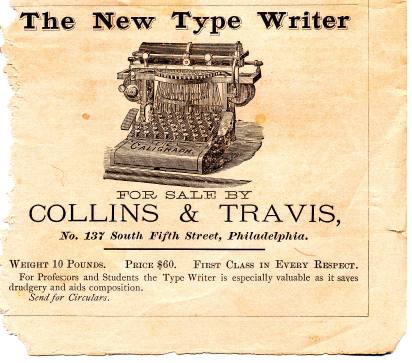
"The New Type Writer" (ad circa 1860's)

(Just for fun, and perspective...)


"Weight 10 pounds. Price $60. First Class in Every Respect.
For Professors and Students the Type Writer is especially valuable as it saves drudgery and aids composition.
Send for Circulars."
(An ad from an issue of the Atlantic Monthly from the 1860's, the magazine that at that time was publishing Ralph Waldo Emerson and all the New England Transcendentalists.
Courtesy of the collection of Ted and Susan Sillars.)

Tuesday, August 01, 2006

No YouTube On Panera Bread’s Menu

I’ve just stumbled upon the strange fact that Panera Bread’s content filter will not let you see anything from YouTube, the homemade-video site, among other things. My laptop and I were having lunch there yesterday – I ordered their turkey artichoke sandwich, while Mac fed on the nutritious free WiFi -- and we noticed that what was supposed to be an embedded YouTube video on another site showed up as a blank space.

Well, shoot happens, and sometimes shoots don’t happen; the Internet is very much a work in progress, and video is still in the pre-standard phase. But with the URL available, curiousity drove us to slap it into the command line, and this rather creepy warning appeared:

“The SonicWALL Content Filter Has Blocked this site.
“Reason for restriction: Forbidden Category"
Sure enough, today we checked back from another i-café (this free wireless thing having freed us from our electronic cave at home), and bada-boom: there was the verboten yet entirely non-controversial video.

Panera is obviously keen on protecting their diners from any unappetizing content -- more likely, protecting themselves from lawsuits from parents whose teens might be tempted to go to there for a bagel and Suzy Creamcheese.

But all of YouTube?

SonicWall can be quite Church-Lady about the content they allow through. Some friends have a completely innocent site about "sound healing," which nonetheless was blocked in the Forbidden Category of "Cult/Occult," a classification which of course does not play in Peoria. To be fair, which I’m frankly not inspired to be in this case, they invite you to submit a rating review “if you feel this site has been blocked in error.” Just don't go to Panera expecting to find anything spicy.