Friday, April 20, 2007

Crackberry Down!

Regarding last week’s post questioning the readiness of the Internet and it’s related ecosystems for Web-only applications:

I thought the 12-hour Blackberry outage Tuesday night illustrated my point in a perfect and timely fashion, although I’ll concede that its users/fans/chattels may find it difficult to find any redeeming qualities in the blackout. Blackberry users had comments (in the Reuters article in eWeek) like, “"I felt like my left arm had been amputated," and the story says that “one Wall Street analyst said she kept hitting her BlackBerry's version of a ‘refresh’ button in disbelief that the system could fail.”

It's looking like I won’t be able to resist quoting a criminal defense lawyer in New York named Charles Ross (though no relation), who said the outage left him feeling "vulnerable and uncomfortable," and that is caused him to miss breakfast! (Okay, “a breakfast appointment.” It only sounded like these people were being denied basic sustenance.)

Now it turns out that all it took was an insufficiently tested routine system upgrade (“to provide better optimization of the system's cache," according to RIM. Appropriate, perhaps, since that upgrade's sure to cost them some extra cash). That’s great – I’m sure if it was an all out criminal-hacker assault, they would have handled it much better.

So, now how do we feel about depending on the Web for even more of our most basic applications? Let me hasten to note that Web apps are a great idea in theory, and probably an inevitable evolution, but that we are (i.e., the Internet is) just not ready for it yet.

RIM explains its BlackBerry outage
Cascading software and system problems caused interruption”
April 20, 2007

A Night Without 'CrackBerry': Curse or Blessing?”
Reuters, by Franklin Paul, via eWeek - April 18
Related, here:
"Baaack it up!" * (Before the Botnets get it) 1/15/07

(...which featured this quote from a Carnegie Mellon computer scientist:
‘The war to make the Internet safe was lost long ago, and we need to figure out what to do now.”)
"A Working Simple System" - John Gall

Wednesday, April 11, 2007

Web-based apps vs. Verizon customer service

Lots of updated buzz recently on the newly dubbed “Webtop,” claimed to be the natural evolutionary successor to the electronic “desktop.” (In quotes because, remember, the original "desktop" is the one that your computer now covers.)

Google, Microsoft and many others imagine that you’d rather use a word processor running on their server farms than one installed on your own, once-“personal” computer. But as of this point in history, the highly touted promise of web-based applications just sounds like a Really Bad Idea (RBI).

(Excuse the interruption, but I’m informed that, especially since it’s the first week of the baseball season, we need to find another HTA -- High Tech Acronym -- for that.)
Think you’re dependent on an Internet connection now? What if you’ve got a thought that you want to get down right away, or a string of numbers you want to add up? Better lay in a supply of pens and yellow pads. If your thinking is as connected to words on paper/screens as mine is, you’re surely going to need them. We're just not there yet, or even very close.

Why, just take the recent case of injured blogger (and NBA hoop artist) Gilbert Arenas, who recently wrote about the hardships of being on the bench during his team’s stretch run to the playoffs. "I think the worst part was that my Internet connection wasn't acting right, so my video game session wasn't working. It kept kicking me offline. So, when you're injured, and video games [are] your life and you can't play, it just makes the injury that much worse."

This guy is a jillionaire, but he was as helpless as you or I when his Internet connection was down. What if he needed to do something important?

But let’s move on to more serious examples. Exhibit B: As it happens, this provides me with the perfect opportunity to rant about… I mean, comment, with oodles of cool, rational objectivity, on the truly dreadful state of Verizon’s DSL customer service.

In my recurring sideline as an indie tech support troubleshooter, I’ve had the delightful chance to spend hours on the phone with Verizon’s woefully under-trained and otherwise unprepared customer service people. And I mean sometimes hours per customer.

It is simply a nightmare. And I want to make it plain that I don’t blame the individual support reps; I’m sure they’re very bright people. Nor do I consider it a reflection on the country these folks are obviously sitting in, in the middle of the night on the other side of the world.

But it really does appear that Verizon, like other solely cost-conscious companies, is trying to do way too much too fast, following the custom of the software industry of working out all the bugs on the general population. One customer was given the most astonishing array of conflicting answers in a series of phone calls that you couldn’t believe they could possibly be from the same company. But sadly, they were.

Then there’s the language problem. I had one conversation where I explained the problem over and over, as clearly and slowly as I could (a no-connection error message dialog that would not go away, interpreting the Cancel button as meaning, “Try again!”), whereupon the support lady’s repeated response was, “Okay, can you explain what problem you are having?”

It was over a half an hour, what with on-hold time and all, before she decided the error message was coming from another department’s turf, and transferred me to someone else. That next rep was a very competent, clever person – her name was Rita, who I believe was sitting in Mexico – who I spent another hour on the line with, as she talked me through a series of command-line exercises.

When we were done, an hour and a half later, all was good – until the next time I rebooted, whereupon the exact same problem reappeared.

The New York Times’ David Pogue recently reprinted a surrealistic transcribed conversation from a Dell customer support call to that same country that I don’t want to blame, but where the people speak a version of English that most Americans find pretty much inscrutable. (That single post attracted 153 "yeah, me too, dammit!" comments.)

I really do feel sorry for those people, because for them this surely must qualify as the High-Paying Job From Hell. Because even when they probably only receive the same dollars per hour as someone starting at Borders Books in the U.S., (where, last I heard, they generously offer the minimum wage,) apparently that’s a lot of money over there. But imagine what they say about us when they’re released from their cube-farm stalls in the morning.

These travesties all come from companies that make their decisions based solely on the short term cost. But they are seriously failing to consider the Total Cost of (customer) Ownership. If the cable companies came up with a competitively priced offering, Verizon would be out of broadband contention in very short order, and deservedly so.

Thursday, March 29, 2007

Time Out (for a good laugh)

(Okay, it may be a bit out of context for a tech/media/business 'blog, but this was just too good not to share, and easily linkable to boot.)
From funnytimes.com, "America's ad-free cartoon and humor newspaper," where they unfortunately don't give any further info on the artist; but the name looks like "horacek."

...but this is the Internet, isn't it?, and sure enough a quick search reveals that indeed the artist's name is Judy Horacek, she's Australian, and here's her own site.

Wednesday, March 28, 2007

Web apps: Are manageable expectations possible?

The people over at Virtual Ubiquity, an early-stage startup hard at work on a Web word processor, are demonstrating their baby at the Web Innovators Group event tonight, and I found their new blog while browsing the various presenters’ sites.

They say they’re “building the first real word processor for the web,” and as a longtime, fulltime user, trainer and envelope-pusher with such software, I had to leave them a comment on it. Never one to pass up a chance to “repurpose” some “content,” I thought I’d just quickly copy my comment here.

What got me going was this, from their blog (the product’s named Buzzword) --

“The development of a real word-processor - whether on the web or on a desktop - is obviously a much bigger task than just deploying a simple rich text editor. Buzzword goes beyond the basic rich formatting available in HTML or AJAX word-processors - we’re doing real-time pagination and layout, so that you will always know what your document will look like when printed. The result is what we think this is the first WYSIWYG word-processor on the web.
So I offered --
Good luck, and remember to deal sternly with Creeping Featureitis. Given that word processing has been widely used for 20 years means there are multimillions of what the clothing store Syms never fails to call “educated consumers.”

And each one of them (I’ll be as guilty as anybody, I’m sure,) will expect all their particular favorite functions to be there, and with the same keyboard shortcuts, too! When you consider how many hundreds of commands have been out there in WP, you’ve got your work cut out for you. Obviously, the biggest job will be deciding what Not to put in.

~~~
Although this is wicked-late notice, considering that it starts in four hours, the Web Innovators Group get-together is always quite the hot ticket; hosted by David Beisel of Masthead Venture Partners, it's even free. It's at the Royal Sonesta in Cambridge at 6:30 (dir's).

I wouldn't even bring it up now if it wasn't for the fact that David generally puts one on every other month, so look for the next around May.

Thursday, March 15, 2007

'The Internet Can't Handle Full-blown TV'

(Ed. Note: This is old "news" -- now backdated over a month! -- but it's stuck in the back of the mind as being one of the issues of larger import heard in the intervening time.)

The top man for TV technology with Google, which acquired YouTube last year, told a European cable group that the Internet was not designed for TV. Companies working on putting broadcast quality TV shows and movies through the Internet were told to rethink their plans.

"'The Web infrastructure, and even Google's (infrastructure) doesn't scale. It's not going to offer the quality of service that consumers expect,' Vincent Dureau, Google's head of TV technology, said at the Cable Europe Congress."
Because (to put it in a few nutshells that I gathered from the article):
"The data involved in one hour of video can equal the total in one year's worth of emails. ISPs are already investing heavily every year just to keep up. YouTube et al may bring the global network to its knees."

("One cable boss in Belgium said it was 'the best news of the day' to hear that Google could not scale for video.")
So, it's looking like we should expect the no-longer "coming" but very much happening TV-Internet convergence to ride on the rails of cable television for the near future, not on just the Internet as is. It'll be a blend, certainly, but with cable companies carrying a lot more of the load than you usually hear. Until the telcos invest heavily enough in fiber optic, that is, at which point all bets are again off.

And, of course, cable's particular capability for this job won't become apparent until worsening response time on the Net starts scoring prominently on the society wide Pain-In-The-Neck Register. Because it does seem, unfortunately, the little ever happens without things first going wrong in dramatic ways.

Google and cable firms warn of risks from Web TV
By Lucas van Grinsven, Reuters, Wed. Feb 7, 2007

Wednesday, March 14, 2007

Starbucks Hears the Music

Naturally, there’s no shortage of opinions that Starbucks has waded in over its head in the wrong pond by starting a record label.

From the AP story (3/13):
“Now, rather than basically lending the Starbucks brand to an album, the Los Angeles-based Hear Music label will sign its own artists and sell records through Starbucks stores and other retailers.”
Makes perfect sense to me: not only has sophisticated music been an essential ingredient in their presentation from the start, but they’ve been pushing individual artists and recordings in their stores for years, and, it’s always seemed, very successfully. (They're quoted as claiming music to be only 1% of their business.)

Of course it’s in character for them: the first part of their name, the leadoff sound, has always been "Star." And success in the music biz has always been about stars and hits – the money’s made with them, which supports the rest of the bets you place in constant search for winners.

Hear Music says they won’t build in any advantage over other retailers in distribution or prices. Music stores had better start serving top-drawer coffee, though: the coffeeshops put their product in front of 44 million customers per week. This should certainly expand their role as another Oprah.

(Thank goodness they seemed to have leveled off from the frenzy of store openings of years past – one of the funniest bits I ever saw in the Onion was about a Starbucks that opened in the restroom of an existing Starbucks. And it is true that a drive down Harvard Ave in Boston, for example, will make you feel like Bill Murray’s Groundhogged newsman. Sure smells good, though.)

Starbucks Launches Record Label
By CURT WOODWARD, AP, 3/13/07
Related, here:
Brick and mortar e-music & bookstores (2/12/07)

Tuesday, March 06, 2007

Payola settlement with Big Radio to boost indie artists

Ironically, on the same day as the bad news for smalltime music webcasters, the news that the FCC is going to force the four major radio broadcasters to play more indie labels and local artists, plus fine the broadcasting co.'s a few mil each.

Well, aah'll be! Never thought I'd see the day. It's not quite the Berlin Wall being torn down, but a bit similar in spirit.

The broadcasting companies involved are CBS Radio, Clear Channel, Entercom, and Citadel.

FCC Settles Payola Case with Giant Radio Firms
broadcast on NPR's All Things Considered, March 5, 2007, by Neda Ulaby
This being National Public Radio, you can also listen to the story, which I heard on my "terrestrial radio" (on WNYE) while driving to Kingston, NY, to meet with a couple companies.

The New York Times' article (by Jeff Leeds) makes the point that it was New York now-Governer Eliot Spitzer who got the ball rolling when he was Attorney General, which, along with his other taking on of the Bigs, got him his new job. The confessed Payolists are now paying "to resolve claims that they accepted cash and other incentives in exchange for playing songs," that they were "auctioning off the airwaves."

(See? They still are called "the airwaves.")

Monday, March 05, 2007

U.S. Copyright Royalty Board deep-6's music Webcasts?

from Wired yesterday, Sunday 3/4. Extracted, tinkered-with quotes (because it's more fun to take the extra step,) of the article in their Listening Post blogcolumn:

The U.S. Copyright Royalty Board (the who?) announced new royalty rates for webcasts, effective from 2006 to 2010. The board apparently simply endorsed the RIAA's proposal, which would force webcasters to pay for each song streamed to each user, estimated at over a penny an hour for each pair of receiving ears.

The Radio and Internet Newsletter (RAIN)'s math indicates the rate would render Internet radio unsustainable, or at the very least, more ad-laden than terrestrial radio(!) -- and that's before the songwriters' licenses are figured in. Even tiny sites would owe the minimum of $500 per channel per year...

Webcasters have a 15-day period to ask the CRB to rehear arguments.

http://blog.wired.com/music/2007/03/us_copyright_ro.html
Here, hear! Easy prediction: besides pulling the plug on smalltime and amateur webcasters, ciao to Web streams of so-called "terrestrial radio" (again, quite a misnomer since you don't stick a radio antenna in the ground; they transmit through what used to be called "the airwaves"). There was a period some years back when some similarly bone-headed ruling made many radio stations decide to take down their Web streams, which then went back up when whoever changed their mind.

"...more ad-laden than terrestrial radio"? Is that even possible? I can't listen to much commercial radio for its oversaturation of ads, a disproportional amount being loud rude ones.

But what'll happen to all those neat stations in iTunes?

Wired's article even has a picture of said Board being sworn in; starting today they'll be sworn at.

Update on the Webcast royalty decision

RAIN (the Radio And Internet Newsletter) quoted in the Wired article says the most successful medium-sized webcaster, Radio Paradise, would owe over 125% of total income. They and the littler guys are toast.

They figure AOL radio would owe $20 million for 2006 -- not only is it retroactive, but increases in each of the five years the ruling will cover.

But -- big surprise -- Clear Channel and the other bigs get off the hook with manageable dues, due to a wrinkle in the Digital Millenium Copyright Act, the infamous DMCA. (Folklore has it that there were some politics involved).

from the RAIN newsletter
(...Because here in America-As-Texas, we like everything BIG. And only big.)

===
The Radio Paradise people started a very passionate Save Internet Radio site, apparently over the weekend.

Monday, February 26, 2007

Al Gore, crusader (& comedian, even!)

(The rare post containing any political content whatsoever)
I missed Al Gore's Oscar acceptance speech for "An Inconvenient Truth," with his remarks appropriately addressed not just to the glitterati and their adorers, or even just the country, but also to "people all over the world," that we must tackle the crisis of our critically deteriorating environment.

I know from having lived many years in some of the most international cities in our country (NY, Miami, now even Boston), and having received quite an earful from many people born somewhere else, that the rest of the world pretty much considers Americans to be completely concentrated on ourselves, to the exclusion of caring about anyone else. So, nice touch, Mr. Gore.

Contrast this with the current V.P.'s incredible statement this past week that "there's no consensus" that human factors are melting the North Pole(!). Wow; now there's some truly superior powers of denial, hm?
All I saw of the "women's Super Bowl" (as it's known in marketing,) besides the performances of the nominated songs was Gore and Leonardo DiCaprio's turn, with their clever bit on, "Are you sure you don't have anything to announce tonight?" Well done. Without belaboring the point too much here, could we not use an otherwise qualified President who isn't afraid to show a little sense of humor? (Or is that just too much to ask in these rancorous times?)

(Reuters version, in two parts:)
"Gore takes center stage at Oscars"
"With Gore's goading, Hollywood goes green at Oscars"

The rare Prediction
While on the subject on Al Gore and what seems like next month's Presidential election (just this once, because politics is not our thing), I'm ready to predict that whoever's nominated for the Democratic ticket will not be someone who has already declared.

The current candidates will be out there as targets for too long, and after they've either run out of steam or been run out of town on a rail, some still relatively untarnished "statesman" (make that "statesperson") will step in to take it. The last one standing, you might say.

This election is reminding me of the way they start Christmas sales the day after Halloween -- hey, that's just too damn early! C'mon, you're spoiling the party.

Friday, February 23, 2007

Invited to do a testimonial for WGBH

I’m very pleased to report being invited to visit Boston’s NPR station, WGBH 89.7 fm, to be interviewed for a testimonial. This is a result of a post in here, Classical Radio Lives To Tell The Tale, from earlier in the winter.

That one was to spread the word on the relocation of the other Boston-area station that plays classical music, WCRB (now at 99.5), at which time I felt happily obliged to mention WGBH.

Why are these stations important? Because, in short, (Western) classical music contains an abundance of qualities which otherwise seem to be in decline in our culture these days, like intelligence and soothing beauty.

To shamelessly quote from November’s entry, these two stations provide “the only consistently quieter, more relaxed sound that’s always available on the public airwaves around here. Concerned about road rage? As thousands of monitored plants from dozens of studies will tell you, classical music is soothing, calming, gently supportive, and all those similar qualities so frighteningly missing from Storrow Drive, Route 128, et al, for at least six hours each weekday.” (That’s my story, and I’m sticking to it.)

Related, here:
Classical Music Lives To Tell The Tale

Monday, February 12, 2007

Brick and mortar e-music & bookstores

I’ve sometimes conducted my web surfing and electronic communications from an independent bookstore, Lord help them, but I feel guilty about it because I never buy anything besides coffee and a pastry.

The last time I moved, I’d accumulated far too many shelves and boxes’ worth of volumes to deal with, and I got to the point of deciding half of them had to go. Either they got read by then or didn’t, but I wasn’t going to move them again, except to the bins in back of the library.

The mad magazine and newspaper reading I used to do (and the Mad Magazine reading, too,) has also been replaced by making the rounds of numerous favored sites, and then a large number of the sites the first ones point me to, work up a lather, repeat as necessary.

There’s so much to read there, such linkical overabundance, you feel as if you never have time for more than a taste of it all. Why buy more of it on paper, which you'll then have to carry back out your door?

So what’s a indie bookstore owner to do? Being so cybernetic, I naturally turned to the idea of suggesting they adapt to, you might say “co-opt,” the competition, that being the electronic distribution of “content.” (Ick -- can’t stand that word, but it is so damnably accurate and convenient, if empty and bland; in fact, the term itself is devoid of content.)
I just had my first encounter a couple weeks back with a Starbucks/Hear Music store in Miami Beach, one of seven in the country, begun in mid 2005. I bought my sister a new Jeff Beck album with singer Imogen Heap and carried it out, which was pretty good considering that they didn’t have it in stock. But they did, of course – in the database.

A resident Starbuckian introduced me to the system, where we just did a search for the album and poured it into a CD, I handed over about 13 bucks and walked out with the disc. They said it was full audio, not MP3s, and it comes in a generic though classy case, with a tiny, maybe 1” square cutout of the album cover.

Imagine, as if CDs weren’t already small-enough canvasses for the once-glorious medium of album cover art. But it’s still pretty cool to combine the vast storage of digital choices with the ability to walk out of a store with something new in your hand. One hopes a little more generous helping of the visuals could be worked out with the rights holders.

The bookstore business is essentially about selling information organized into ideas and products for consumption. How about making the store a destination where people can lounge around in the contemporary fashion, wirelessly connected, sipping on downloads and highly customized digital offerings?

What can a store offer that a downloader can't get at home, at least in the same way?
• wide-angle viewing of visual media
• a (semi-)professionally produced product, for show and tell with their friends
• community
• coffee (not their same old grind,) and snacks

Thursday, February 08, 2007

"18 inventors picked to join Hall of Fame"

(From the story by Natasha T. Metzler, AP - here in BusinessWeek:)

"Inventors of the MRI, the Ethernet, the LP record and a popular weedkiller are among 18 people picked for induction into the National Inventors Hall of Fame (founded by the U.S. Patent & Trademark Office and the National Council of Intellectual Property Law Associations).

"The 2007 class of inductees, announced Thursday, join luminaries such as Thomas Edison, Velcro inventor George de Mestral and Charles Goodyear, developer of vulcanized rubber..."

I can certainly relate to the LP record, the Ethernet standard, and the packet switch, another inductee, and acknowledge that magic combination of Vision and Make-It-Happenitude of their inventors (respectively, the late Peter C. Goldmark, Bob Metcalfe, Paul Baran).

But, tragically mindful of the TCI (Total Cost of Inventions), the mention of weedkiller reminds me, once again, I hope they’re also paying attention to technologies that clean house and pick up after other, messy technologies.

The other question I had regarding these Hall Of Fame selections was, why didn't they list the inductees' lifetime batting averages?

(Magazine cover: "Build Your Own Television Receiver," from 1928.)

NYC to ban PEDs outdoors?

New York City continues to make news, now with the proposed ban on pedestrian use of Portable Electronic Devices (PED – and you may have heard that HTA* here first).

A New York State Senator who shall remain mercifully nameless has proposed a ban on not just the headline-grabbing Podthing but on the whole Boysenberry/ cell phone/ video game/ palm-sized-home-theater gestault. It will be against the law to appear to be in a state of "iPod oblivion" while on a public thoroughfare.

General opinion goes well beyond mere disapproval, tending towards the slightly incredulous. At the end of this article by India’s Techtree.com, a commenter in California put it succinctly: “You can't fix stupid.”

Some predictable smirks in the headlines for a caper like this --

Lawmaker wants to outlaw street grooves said Earthtimes.org, stating the law will be for “fining pedestrians caught grooving to MP3 players while crossing the street.”

Move's afoot in NY to force iPod pedestrians to unplug
- Seattle Times, WA, where a a civil-liberties attorney suggests we also go ahead with ticketing people when they don’t look both ways before crossing.
(That's not a bad idea to consider, from all the angles, since the approaching saturation point of video surveillance, with software monitoring, will actually make that do-able.)

I mean, we did survive the Sony Walkman (or… did we, really?), an early, now-extinct species that once stalked the earth in great numbers. It bore a startling resemblance to a Pod, except that it was manually fed and the earbuds were inside-out.

It brings to mind a favorite quote of Opus (the Penguin, of course, Berke Breathed's subconscious voice): “Go away, you lawyers! Whatever happened to personal responsibility?”
( * - "High Tech Acronym," of course. And the PED thing is just a wisecrack, alright?)

But while e-jaywalking laws seem a stretch, the sense-saturating potency of all the devices we’re expected to carry around does create a situation that'll have to be dealt with. The story in Australian IT, discussing the two pedestrians who died after walking in front of moving vehicles, cites the fact that, “in one case bystanders screamed ‘watch out’ to no avail.”

Tuesday, February 06, 2007

Releasing the spiders, & letting Boston off the hook

Technorati Profile
(They have you save a post with the above link for signup confirmation; finally decided to join and get in the swim of it all, after having been weblogging for almost a year now.)

Hey, don't blame me for the spiders in the title -- that's what the button in Technorati says. Being in a town that just had a 2-million-dollar cow over boxes with flashing lights under bridges, one can't be too careful with what you say these days.

Listen, while we're at it, go easy on Boston over this one, alright?, despite the fact the same promotion went off without any fuss in all the other major U.S. cities. Remember that two of the planes of September 11th took off from Logan airport, and that we get these LNG supertankers in Boston Harbor, and that makes you kinda nervous.

Just as when I was obligated to wait on line last week to then hurriedly disrobe and empty my pockets to get on a flight, we've got to be ready and willing to put up with all the hassle that comes from erring on the side of caution. (Why, they even took away my aloe vera gel -- I was unwittingly carrying more then three ounces.)

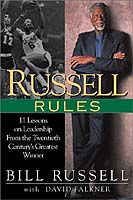
In my case, I had a small reward: at the Newark airport, I turned around to find none other than Bill Russell standing behind me(!) It was 6:30 am, and he plainly was not ready to start talking to anyone, so I just told him, "Mr. Russell, it's an honor."

No sooner had the words left my mouth than someone from the airline came up to escort him around the interrogation line, which I thought was only appropriate for such an accomplished and principled gentleman.

Excerpts from his 2001 book, "Russell Rules : 11 Lessons on Leadership from the Twentieth Century's Greatest Winner"

Sunday, February 04, 2007

Endless Vistas... of confusion

Having been at this tech thing for a goodly amount of time, I've had this policy (and learned survival skill) for almost as long: Never Buy The 1.0 Version Of Anything.

So it's been with a complete lack of surprise that I've been watching the news of Microsoft's introduction of Windows 05 (which drifted to 06... no, make that '07). IDG's Computerworld, which has been around since only the giant Mainframus Rex roamed the earth, put it succinctly (Jan. 25):
"Wait! Don't buy Windows Vista! Microsoft's new OS is the best Windows ever. But don't buy it!"

They've updated that story since (Feb. 2, by Mike Elgan,) with the amusing headline, "Windows Vista: The 'Huh?' starts now; Microsoft is confusing everyone with its new OS..." The story explains that no one knows for sure what you'll have to do to upgrade from XP: "Microsoft created this confusion by failing to tell anyone what the proof requirement would be for using an Upgrade version of Vista. Meanwhile, the Upgrade versions are poison."

Then there's the fact that MS has introduced Vista in "10 -- count 'em, 10 -- versions. Instead of giving us a simple new upgrade path to the future, they instead gave us a homework assignment."

But wait, there's more! The first "service pack" from Microsoft -- aka, bug fixes -- won't be available until late in the year. Major peripheral vendors aren't ready yet for the new operating system. (Also, attention iPod Nation, Apple is warning everyone not to upgrade to Vista yet if you want your iTunes to work, at least until the next version of iTunes "in the next few weeks.")

The Why's and How's
It's like this: software companies only make real money when they ship a major new version. It's sad but true, but most often software that's shipped (by just about everybody, and I'd love to know who this isn't true of,) is still in the beta stage, and the companies depend on the unpaid labor of all the eager-beaver early adopters, and innocent newbies, to debug their software for them.

Generally, by the time the second update is available, that application is ready for primetime. But not before.

Vista has been delayed over a year (and retailers were dismayed, to put it mildly, when it wasn't ready as promised for their biggest season, the holidays), so just as with the famous release of Windows 95 so many years ago, with 3000 known bugs, MS pushed this release out the door before they had to start to consider closing theirs.

Related, on Rosswriting.com:Scouting the Techno-Frontier
(An editorial for the AltaVista MarketSpace webzine, 1997-98)

Wednesday, January 17, 2007

Engineers Rule -- Again?

I could not resist a quick comment on a 1/16 article in Wired on "How Yahoo Blew It" (via the Boston Globe's Business Filter).

The article concludes, "At Yahoo, the marketers rule, and at Google the engineers rule. And for that, Yahoo is finally paying the price."

As a former Digital employee, I found this highly ironic: being an engineering-driven company was exactly what was usually blamed for DEC going down, down, and finally out.

"And the seasons, they go round and round...", in Joni's words.

Is quoting a lyricist too cheesy? Okay, then, how about Sir Isaac Newton, the inventor of gravity? As Newton's Second Law of Psychics states, "What goes around, comes around."
(...Excuse me, I'm getting a call from the Editor; just continue reading, and I'll get back to you with whatever little copy edits he might have. "What is it now? Can't you see I'm busy!?")
(Back to the serious part --)
Last summer, I went to a groundbreaking at Gordon College where Ken Olsen was being honored by naming their new science building after him. I got close enough to watch as a steady stream of his former employees came up to express their heartfelt appreciations to him, and got to see the flash in his eyes. So only then, since he was gone from Digital by the time I worked there, I felt like I got to see who Ken Olsen really was.

But I sure got to hear a lot about him from the old DEC people who were still there, and the story was told that when he came into the company cafeteria, he'd pass by all the execs and go have lunch with... the engineers.

That stuff about Google people getting a day a week to work on their own projects? That's exactly what was going on at Digital in its heyday, and it all came from Ken.


Ken Olsen, in 1972
(from DECedOut.org, a site by and for loyalists)

Monday, January 15, 2007

"Baaack it up!" * (Before the Botnets get it)

Here’s one of the most ancient and didactic of the sacred injunctions of Computerdom, but one which potentially carries an even greater urgency for us now:

MAKE BACKUPS OF ALL YOUR VITAL INFORMATION --- Today

(How boring, I know: it tends to fall into that same bin with your dear sainted Mother telling you to clean up your room, or to stop doing whatever it was that you kept doing that just really drove your mother up the wall. But it’s one of those simple essentials we all know is true, yet somehow still need regular reminders to do.)

What sparked this particular ringing of the alarm was a positively scarifyin’ article by John Markoff in the New York Times last week, on the “Attack of the Zombie Computers” (which, damn, they've already archived and are charging for).
===

Botnets -- programs that secretly install themselves on perhaps millions of personal computers and band them together into a network to commit Internet crimes – “are being blamed for the huge spike in spam that bedeviled the Internet in recent months, as well as fraud and data theft. Security researchers have been concerned about botnets for some time... what is new is the vastly escalating scale of the problem."

"A security researcher analyzed the information contained in one 200-megabyte file that he had intercepted. The data came from 793 infected computers, and in a 30-day period, it generated 54,926 log-in credentials and 281 credit-card numbers, affecting 1,239 companies, including 35 stock brokerages, 86 bank accounts, 174 e-commerce accounts and 245 e-mail accounts."
That was in one file.
Said “David J. Farber, a Carnegie Mellon computer scientist and an Internet pioneer, ‘It’s an insidious threat, and what worries me is that the scope of the problem is still not clear to most people.’ Referring to Windows computers, he added, ‘The popular machines are so easy to penetrate, and that’s scary.’”

“The consensus among scientists is that botnet programs are present on about 11 percent of the more than 650 million computers attached to the Internet. A computer security researcher… who coordinates an international volunteer effort to fight botnets (said,) ‘The war to make the Internet safe was lost long ago, and we need to figure out what to do now.’”
Let’s revisit that last statement: “The war to make the Internet safe was lost long ago.” You know, just a moment of consideration of this concept, assuming it’s credible, must give one pause. We could quite possibly wake up one day and find the Internet down. Really down; brought to its knees.

But you don’t need the Web to crash for it to be a disaster; it could be your own personal information swiped from your computer, or the system of a company you’d entrusted some juicy bits to. Perhaps you’d hear a lonely whistling sound, as the breeze blew through your empty bank account.

I really don’t think this is alarmist in any extreme way. “Shift Happens.” We’ve just got to be truly prudent, and create our own backups. Then, if the unimaginable does occur, you can say, with considerable relief, “Well, at least I’ve got a copy of everything.” (That might be handy if you had to go to court to get your money back from the bank, for instance. You know, the one that charges you $35 for any oversight or slip of the pen?)

Protecting the data on your machine is just the start. For example, I’ve got one bank account that I use (sparingly) to buy things over the phone or Web, but I just leave a little in there, and the bulk in other, disconnected accounts. It’s not foolproof, but it lessens the odds of potentially getting thoroughly cleaned out in one swell foop.
===

Related, here:
"Hey, NYT, What About Fair Use?"
===
* - “Baaack it up!” Couldn’t resist quoting the anonymous garbageman who woke me with this cry every early morning, numerous years ago, as he guided his truck in backwards to pick up the refuse from the restaurant I lived next door to.
(That was “Maddies,” for you Marbleheaders, which is actually named “The Sail Loft.”)

Wednesday, January 10, 2007

Great Signs, and one wonders...

Found while searching for something else -- some irresistably funny signage:

(The bottom line reads, "Also, the bridge is out ahead." Oh; thanks.)

Another clever one:
Kudos to North Vancouver.

This is from an inscrutable weblog named, "City Comforts, temporarily known as Viaduct, the blog." Huh? It then contains the mysterious description, "What was this Blog About?", which they claim was, "Cities, architecture, the 'new urbanism,' real estate, historic preservation, urban design..." So naturally, the current item at the moment is on the new Apple iPhone (but I'm linking here to Macworld's take).

It appears they have a big debate going on in Seattle about fixing the Viaduct, asking the timeless question, "Could Seattle do without its elevated highway?" Funny to read from a Boston perspective, where they went in the opposite direction and Dug Big, for the greatest public work project/boondoggle in history. With that in mind, we applaud Seattle's elevated thinking.

Monday, January 08, 2007

Planting Seeds of Synergy

I just participated in a reasonably unique event this past weekend, and thought it would be a very good one to share. In a word, it was and is all about chemistry.

Mitch Ditkoff, founder and fearless leader of Idea Champions, a New York-based corporate training company (who I occasionally do some writing and training for), decided to bring together all the different people who work for them, to see what untapped interactions might result.

He announced it as, “a gathering of great souls, mavericks, innovators, free electrons and other assorted gypsies who will be working with Idea Champions in 2007.” (That’s pure Mitch-ese; but it’s always offered with a wink.) “The purpose of this gathering is for us to get to know each other a little better. I know all of you, but all of you don't necessarily know each other. There are a lot of synergies, positive sparks, and collaborations just waiting to happen…”

And, boy, did they ever. The old saw, “the atmosphere was electric” found its full expression in that room. I thought I’d pass this wonderful idea along, for anyone who collaborates with physically disconnected knowledge-worker units. For all the unquestionable benefits of electronic communication, I've come to the conclusion that there's a level where it's still very much a face-to-face world.

(That great "out of the box" illustration above was done for I.C. by Kent Lew.)
~~~
Mitch and his team are also notable for developing Free The Genie, “a deck of 55 creative thinking cards that help aspiring innovators get unstuck, out of the box, and achieve extraordinary results.”

(Blogospherists: no less a luminary than Seth Godin said about Free The Genie, "This is really, really good stuff.")

Related, here:
The "(How-Not-To-Approach-An) Innovation Committee" skit

Tuesday, January 02, 2007

Happy New Year, Month, Day...

In what I promise is the last of these meandering, relatively off-topic holiday posts:

I'm in NYC for a bit, so I decided to go, for the first time, to Times Square for the New Year's madness. You know, it's one of those either you've-got-to-do-it-once or once-is-enough things; I thought I'd go and see which one it turned out to be. That would be the latter; although it was fun and I am glad I went. Once.

Almost chickened out when I read in the days before that the city expected one million people -- 1,000,000 people! -- to be there, and that the police would be herding them into "pens" to keep things under control. So I decided to just go into the area for awhile earlier, then leave, just so I could catch the flavor and energy of it all. Of course, once I got there, obviously the only proper thing to do was stay for the climax.

There had to be vids of it on YouTube, because there were so many people holding their camcorders over their heads taping it, and sure enough, a search on YT for "Times Square New Years 2007" produces an ample supply.

I picked this video because that's as close as I got: at 57th Street on 7th Avenue, 15 blocks away. We could see The Ball, though it's hard to spot here; it descended into the spot where the fireworks come from. The papers suggested that you get there by 5 pm to get a penned-in spot in Times Square, where you would then not be allowed to leave for food or any other calls of nature. Uh, no thank you; I was going for a good time.


...and you are there! Sort of.

http://www.youtube.com/watch?v=1Jg-5S1U7tU